
- Create VPC 首先選擇 VPC with a Single Public Subnet Only,逐步按continue即可
-
 這裡我們只使用一個subnet 10.0.0.0/24
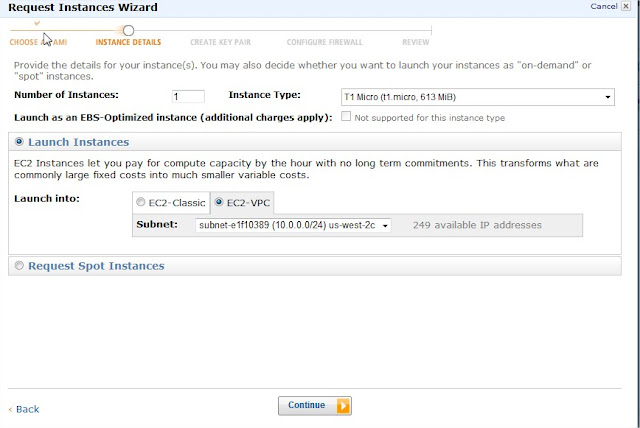
- Launch EC2 instance with OpenVpn 首這裡比較需要注意是要溝選掛在EC2-VPC
輸入keypair記得按download下來之後ssh登錄需要使用
 因為我是要裝openvpn所以相關port要打開
 安裝完之後會自動啟動, 根據文件disable Change Source/Dest. Check.
 Disable Source/Dest checking on both instances by right-clicking the instances and selecting Change Source/Dest. Check.
-
Configure
the Linux instances to route traffic by editing /etc/sysctl.conf and
change the net.ipv4.ip_forward variable from 0 to 1
-
Prompt> sudo vi /etc/sysctl.conf
-
net.ipv4.ip_forward = 1
-
Restart your network settings for the network forwarding settings to take effect.
-
Prompt> sudo service network restart
接下來Elastic IPs allocate一個ip給 instance,然後使用putty ssh登錄
參考阿正老師的登錄方式
因為EC2的金鑰是以.pem檔來儲存,Putty無法直接使用,因此我們必須先下載Puttygen來做金鑰的轉檔
若不想每次進去都要使用金鑰
Ubuntu版 第一次登錄時請使用帳號ubuntu
※免憑證登入EC2
如果覺得每次登入都給用金鑰很麻煩, 可以將金鑰登入方式改成帳號密碼..
1. 以root身份修改 sudo vim /etc/ssh/sshd_config, 把
PasswordAuthentication no 改成
PasswordAuthentication yes
2. 重新啟動sshd
sudo service ssh restart 跟centos 版不一樣
接著設定使用帳號的密碼即可.
Centos版 第一次登錄時請使用帳號ec2-user
因為ec2的vps預設不讓你用su指令切換成root,因此可以輸入下面這行指令換掉root的密碼:
sudo passwd root
1.以root的身份修改 /etc/ssh/sshd_config,找到第60行 PasswordAuthentication no,把no改成yes,如下圖
2.然後重新啟動sshd
sudo /sbin/service sshd restart
然後以root身份輸入
passwd ec2-user
改掉預設使用者「ec2-user」的密碼,以後再用putty登入ssh時就可以不用選擇金鑰檔,只要直接輸入密碼就可以登入EC2的虛擬機器了。
centos版openvpn安裝
yum update
yum -y install openvpn
cd /usr/share/openvpn/easy-rsa/2.0
可以先vim vars文件修改國家省份等資訊建憑證時要用
source vars
./clean-all
./build-ca
./build-key-server server
./build-dh
在此可順便建client的憑證 要使用幾個client就要建幾個,之後安裝client openvpn可以使用
./build-key client1
./build-key client2
./build-key client3
這樣server端憑證就建完了會產生在一個keys的資料夾
cp -r keys /etc/openvpn
找到server.conf的sample來修改
cp /usr/share/doc/openvpn-2.2.2/sample-config-files/server.conf /etc/openvpn
vim /server.conf 如下:
# Which local IP address should OpenVPN
# listen on? (optional)
;local a.b.c.d
# Which TCP/UDP port should OpenVPN listen on?
# If you want to run multiple OpenVPN instances
# on the same machine, use a different port
# number for each one. You will need to
# open up this port on your firewall.
port 1194
# TCP or UDP server?
;proto tcp
proto udp
# "dev tun" will create a routed IP tunnel,
# "dev tap" will create an ethernet tunnel.
# Use "dev tap0" if you are ethernet bridging
# and have precreated a tap0 virtual interface
# and bridged it with your ethernet interface.
# If you want to control access policies
# over the VPN, you must create firewall
# rules for the the TUN/TAP interface.
# On non-Windows systems, you can give
# an explicit unit number, such as tun0.
# On Windows, use "dev-node" for this.
# On most systems, the VPN will not function
# unless you partially or fully disable
# the firewall for the TUN/TAP interface.
;dev tap
dev tun
# Windows needs the TAP-Win32 adapter name
# from the Network Connections panel if you
# have more than one. On XP SP2 or higher,
# you may need to selectively disable the
# Windows firewall for the TAP adapter.
# Non-Windows systems usually don't need this.
;dev-node MyTap
# SSL/TLS root certificate (ca), certificate
# (cert), and private key (key). Each client
# and the server must have their own cert and
# key file. The server and all clients will
# use the same ca file.
#
# See the "easy-rsa" directory for a series
# of scripts for generating RSA certificates
# and private keys. Remember to use
# a unique Common Name for the server
# and each of the client certificates.
#
# Any X509 key management system can be used.
# OpenVPN can also use a PKCS #12 formatted key file
# (see "pkcs12" directive in man page).
ca /etc/openvpn/keys/ca.crt
cert /etc/openvpn/keys/server.crt
key /etc/openvpn/keys/server.key # This file should be kept secret
# Diffie hellman parameters.
# Generate your own with:
# openssl dhparam -out dh1024.pem 1024
# Substitute 2048 for 1024 if you are using
# 2048 bit keys.
dh /etc/openvpn/keys/dh1024.pem
# Configure server mode and supply a VPN subnet
# for OpenVPN to draw client addresses from.
# The server will take 10.8.0.1 for itself,
# the rest will be made available to clients.
# Each client will be able to reach the server
# on 10.8.0.1. Comment this line out if you are
# ethernet bridging. See the man page for more info.
server 10.8.0.0 255.255.255.0 #openvpn 啟動時subnet會是10.8.0.1/24, ip:10.8.0.1
# Maintain a record of client <-> virtual IP address
# associations in this file. If OpenVPN goes down or
# is restarted, reconnecting clients can be assigned
# the same virtual IP address from the pool that was
# previously assigned.
ifconfig-pool-persist ipp.txt
# Configure server mode for ethernet bridging.
# You must first use your OS's bridging capability
# to bridge the TAP interface with the ethernet
# NIC interface. Then you must manually set the
# IP/netmask on the bridge interface, here we
# assume 10.8.0.4/255.255.255.0. Finally we
# must set aside an IP range in this subnet
# (start=10.8.0.50 end=10.8.0.100) to allocate
# to connecting clients. Leave this line commented
# out unless you are ethernet bridging.
;server-bridge 10.8.0.4 255.255.255.0 10.8.0.50 10.8.0.100
# Configure server mode for ethernet bridging
# using a DHCP-proxy, where clients talk
# to the OpenVPN server-side DHCP server
# to receive their IP address allocation
# and DNS server addresses. You must first use
# your OS's bridging capability to bridge the TAP
# interface with the ethernet NIC interface.
# Note: this mode only works on clients (such as
# Windows), where the client-side TAP adapter is
# bound to a DHCP client.
;server-bridge
# Push routes to the client to allow it
# to reach other private subnets behind
# the server. Remember that these
# private subnets will also need
# to know to route the OpenVPN client
# address pool (10.8.0.0/255.255.255.0)
# back to the OpenVPN server.
;push "route 192.168.10.0 255.255.255.0"
;push "route 192.168.20.0 255.255.255.0"
push "route 10.0.0.0 255.255.255.0"
#push route vpc的subnet 10.0.0.0/24 這樣 10.8.0.0網段才可以連到10.0.0.0網段
只設定上面筆電連上vpn後只能ping到vpn主機1.0.0.99(有設elastic ip)
另一台private ip卻ping不到,後來在vpc route tables add 10.8.0.0/24即可成功(要選擇 association with 10.0.0.0/24 subnet)

# To assign specific IP addresses to specific
# clients or if a connecting client has a private
# subnet behind it that should also have VPN access,
# use the subdirectory "ccd" for client-specific
# configuration files (see man page for more info).
# EXAMPLE: Suppose the client
# having the certificate common name "Thelonious"
# also has a small subnet behind his connecting
# machine, such as 192.168.40.128/255.255.255.248.
# First, uncomment out these lines:
;client-config-dir ccd
;route 192.168.40.128 255.255.255.248
#client-config-dir /etc/openvpn/ccd
#route 124.0.0.0 255.255.255.0
# Then create a file ccd/Thelonious with this line:
# iroute 192.168.40.128 255.255.255.248
# This will allow Thelonious' private subnet to
# access the VPN. This example will only work
# if you are routing, not bridging, i.e. you are
# using "dev tun" and "server" directives.
# EXAMPLE: Suppose you want to give
# Thelonious a fixed VPN IP address of 10.9.0.1.
# First uncomment out these lines:
;client-config-dir ccd
;route 10.9.0.0 255.255.255.252
# Then add this line to ccd/Thelonious:
# ifconfig-push 10.9.0.1 10.9.0.2
# Suppose that you want to enable different
# firewall access policies for different groups
# of clients. There are two methods:
# (1) Run multiple OpenVPN daemons, one for each
# group, and firewall the TUN/TAP interface
# for each group/daemon appropriately.
# (2) (Advanced) Create a script to dynamically
# modify the firewall in response to access
# from different clients. See man
# page for more info on learn-address script.
;learn-address ./script
# If enabled, this directive will configure
# all clients to redirect their default
# network gateway through the VPN, causing
# all IP traffic such as web browsing and
# and DNS lookups to go through the VPN
# (The OpenVPN server machine may need to NAT
# or bridge the TUN/TAP interface to the internet
# in order for this to work properly).
;push "redirect-gateway def1 bypass-dhcp"
# Certain Windows-specific network settings
# can be pushed to clients, such as DNS
# or WINS server addresses. CAVEAT:
# http://openvpn.net/faq.html#dhcpcaveats
# The addresses below refer to the public
# DNS servers provided by opendns.com.
;push "dhcp-option DNS 208.67.222.222"
;push "dhcp-option DNS 208.67.220.220"
# Uncomment this directive to allow different
# clients to be able to "see" each other.
# By default, clients will only see the server.
# To force clients to only see the server, you
# will also need to appropriately firewall the
# server's TUN/TAP interface.
;client-to-client
# Uncomment this directive if multiple clients
# might connect with the same certificate/key
# files or common names. This is recommended
# only for testing purposes. For production use,
# each client should have its own certificate/key
# pair.
#
# IF YOU HAVE NOT GENERATED INDIVIDUAL
# CERTIFICATE/KEY PAIRS FOR EACH CLIENT,
# EACH HAVING ITS OWN UNIQUE "COMMON NAME",
# UNCOMMENT THIS LINE OUT.
;duplicate-cn
# The keepalive directive causes ping-like
# messages to be sent back and forth over
# the link so that each side knows when
# the other side has gone down.
# Ping every 10 seconds, assume that remote
# peer is down if no ping received during
# a 120 second time period.
keepalive 10 120
# For extra security beyond that provided
# by SSL/TLS, create an "HMAC firewall"
# to help block DoS attacks and UDP port flooding.
#
# Generate with:
# openvpn --genkey --secret ta.key
#
# The server and each client must have
# a copy of this key.
# The second parameter should be '0'
# on the server and '1' on the clients.
;tls-auth ta.key 0 # This file is secret
# Select a cryptographic cipher.
# This config item must be copied to
# the client config file as well.
;cipher BF-CBC # Blowfish (default)
;cipher AES-128-CBC # AES
;cipher DES-EDE3-CBC # Triple-DES
# Enable compression on the VPN link.
# If you enable it here, you must also
# enable it in the client config file.
comp-lzo
# The maximum number of concurrently connected
# clients we want to allow.
;max-clients 100
# It's a good idea to reduce the OpenVPN
# daemon's privileges after initialization.
#
:
#
# You can uncomment this out on
# non-Windows systems.
;user nobody
;group nobody
# The persist options will try to avoid
# accessing certain resources on restart
# that may no longer be accessible because
# of the privilege downgrade.
persist-key
persist-tun
# Output a short status file showing
# current connections, truncated
# and rewritten every minute.
status openvpn-status.log
# By default, log messages will go to the syslog (or
# on Windows, if running as a service, they will go to
# the "\Program Files\OpenVPN\log" directory).
# Use log or log-append to override this default.
# "log" will truncate the log file on OpenVPN startup,
# while "log-append" will append to it. Use one
# or the other (but not both).
;log openvpn.log
;log-append openvpn.log
# Set the appropriate level of log
# file verbosity.
#
# 0 is silent, except for fatal errors
# 4 is reasonable for general usage
# 5 and 6 can help to debug connection problems
# 9 is extremely verbose
verb 3
# Silence repeating messages. At most 20
# sequential messages of the same message
# category will be output to the log.
;mute 20
儲存後可開啟server
sudo service openvpn restart
sudo service openvpn stop
sudo /etc/init.d/openvpn restart
sudo /etc/init.d/openvpn stop
安裝window7 openvpn client
開啟瀏覽器搜尋”openvpn gui”,搜尋後點選 “OpenVPN GUI for Windows” 。
Download 裡,點選一個stable選項。
請選擇如下安裝:Installation Package(Both 32-bit and 64-bit TAP driver included):openvpn-2.0.9-gui-1.0.3-install.exe
於下載好的位置,會看到openvpn-2.0.9-gui-1.0.3-install.exe軟體,請安裝好(安裝過程,都預設安裝即可) 。
win7安裝很多問題,記得去網路找
openvpn-2.1_rc15-install這版本安裝,安裝前要先勾選如下圖,安裝時請按右鍵使用系統管理員身份安裝即可


 因為我是要裝openvpn所以相關port要打開
安裝完之後會自動啟動, 根據文件disable Change Source/Dest. Check.

Disable Source/Dest checking on both instances by right-clicking the instances and selecting Change Source/Dest. Check.
- Configure the Linux instances to route traffic by editing /etc/sysctl.conf and change the net.ipv4.ip_forward variable from 0 to 1
- Prompt> sudo vi /etc/sysctl.conf
- net.ipv4.ip_forward = 1
- Restart your network settings for the network forwarding settings to take effect.
- Prompt> sudo service network restart
Ubuntu版 第一次登錄時請使用帳號ubuntu
※免憑證登入EC2
如果覺得每次登入都給用金鑰很麻煩, 可以將金鑰登入方式改成帳號密碼..
1. 以root身份修改 sudo vim /etc/ssh/sshd_config, 把
PasswordAuthentication no 改成
PasswordAuthentication yes
2. 重新啟動sshd
sudo service ssh restart 跟centos 版不一樣
接著設定使用帳號的密碼即可.
Centos版 第一次登錄時請使用帳號ec2-user
因為ec2的vps預設不讓你用su指令切換成root,因此可以輸入下面這行指令換掉root的密碼:
sudo passwd root
1.以root的身份修改 /etc/ssh/sshd_config,找到第60行 PasswordAuthentication no,把no改成yes,如下圖
2.然後重新啟動sshd
sudo /sbin/service sshd restart
然後以root身份輸入
passwd ec2-user
改掉預設使用者「ec2-user」的密碼,以後再用putty登入ssh時就可以不用選擇金鑰檔,只要直接輸入密碼就可以登入EC2的虛擬機器了。
centos版openvpn安裝
yum update
yum -y install openvpn
cd /usr/share/openvpn/easy-rsa/2.0
可以先vim vars文件修改國家省份等資訊建憑證時要用
source vars
./clean-all
./build-ca
./build-key-server server
./build-dh
在此可順便建client的憑證 要使用幾個client就要建幾個,之後安裝client openvpn可以使用
./build-key client1
./build-key client2
./build-key client3
這樣server端憑證就建完了會產生在一個keys的資料夾
cp -r keys /etc/openvpn
找到server.conf的sample來修改
cp /usr/share/doc/openvpn-2.2.2/sample-config-files/server.conf /etc/openvpn
vim /server.conf 如下:
# Which local IP address should OpenVPN
# listen on? (optional)
;local a.b.c.d
# Which TCP/UDP port should OpenVPN listen on?
# If you want to run multiple OpenVPN instances
# on the same machine, use a different port
# number for each one. You will need to
# open up this port on your firewall.
port 1194
# TCP or UDP server?
;proto tcp
proto udp
# "dev tun" will create a routed IP tunnel,
# "dev tap" will create an ethernet tunnel.
# Use "dev tap0" if you are ethernet bridging
# and have precreated a tap0 virtual interface
# and bridged it with your ethernet interface.
# If you want to control access policies
# over the VPN, you must create firewall
# rules for the the TUN/TAP interface.
# On non-Windows systems, you can give
# an explicit unit number, such as tun0.
# On Windows, use "dev-node" for this.
# On most systems, the VPN will not function
# unless you partially or fully disable
# the firewall for the TUN/TAP interface.
;dev tap
dev tun
# Windows needs the TAP-Win32 adapter name
# from the Network Connections panel if you
# have more than one. On XP SP2 or higher,
# you may need to selectively disable the
# Windows firewall for the TAP adapter.
# Non-Windows systems usually don't need this.
;dev-node MyTap
# SSL/TLS root certificate (ca), certificate
# (cert), and private key (key). Each client
# and the server must have their own cert and
# key file. The server and all clients will
# use the same ca file.
#
# See the "easy-rsa" directory for a series
# of scripts for generating RSA certificates
# and private keys. Remember to use
# a unique Common Name for the server
# and each of the client certificates.
#
# Any X509 key management system can be used.
# OpenVPN can also use a PKCS #12 formatted key file
# (see "pkcs12" directive in man page).
ca /etc/openvpn/keys/ca.crt
cert /etc/openvpn/keys/server.crt
key /etc/openvpn/keys/server.key # This file should be kept secret
# Diffie hellman parameters.
# Generate your own with:
# openssl dhparam -out dh1024.pem 1024
# Substitute 2048 for 1024 if you are using
# 2048 bit keys.
dh /etc/openvpn/keys/dh1024.pem
# Configure server mode and supply a VPN subnet
# for OpenVPN to draw client addresses from.
# The server will take 10.8.0.1 for itself,
# the rest will be made available to clients.
# Each client will be able to reach the server
# on 10.8.0.1. Comment this line out if you are
# ethernet bridging. See the man page for more info.
server 10.8.0.0 255.255.255.0 #openvpn 啟動時subnet會是10.8.0.1/24, ip:10.8.0.1
# Maintain a record of client <-> virtual IP address
# associations in this file. If OpenVPN goes down or
# is restarted, reconnecting clients can be assigned
# the same virtual IP address from the pool that was
# previously assigned.
ifconfig-pool-persist ipp.txt
# Configure server mode for ethernet bridging.
# You must first use your OS's bridging capability
# to bridge the TAP interface with the ethernet
# NIC interface. Then you must manually set the
# IP/netmask on the bridge interface, here we
# assume 10.8.0.4/255.255.255.0. Finally we
# must set aside an IP range in this subnet
# (start=10.8.0.50 end=10.8.0.100) to allocate
# to connecting clients. Leave this line commented
# out unless you are ethernet bridging.
;server-bridge 10.8.0.4 255.255.255.0 10.8.0.50 10.8.0.100
# Configure server mode for ethernet bridging
# using a DHCP-proxy, where clients talk
# to the OpenVPN server-side DHCP server
# to receive their IP address allocation
# and DNS server addresses. You must first use
# your OS's bridging capability to bridge the TAP
# interface with the ethernet NIC interface.
# Note: this mode only works on clients (such as
# Windows), where the client-side TAP adapter is
# bound to a DHCP client.
;server-bridge
# Push routes to the client to allow it
# to reach other private subnets behind
# the server. Remember that these
# private subnets will also need
# to know to route the OpenVPN client
# address pool (10.8.0.0/255.255.255.0)
# back to the OpenVPN server.
;push "route 192.168.10.0 255.255.255.0"
;push "route 192.168.20.0 255.255.255.0"
push "route 10.0.0.0 255.255.255.0"
#push route vpc的subnet 10.0.0.0/24 這樣 10.8.0.0網段才可以連到10.0.0.0網段
只設定上面筆電連上vpn後只能ping到vpn主機1.0.0.99(有設elastic ip)
另一台private ip卻ping不到,後來在vpc route tables add 10.8.0.0/24即可成功(要選擇 association with 10.0.0.0/24 subnet)

# To assign specific IP addresses to specific
# clients or if a connecting client has a private
# subnet behind it that should also have VPN access,
# use the subdirectory "ccd" for client-specific
# configuration files (see man page for more info).
# EXAMPLE: Suppose the client
# having the certificate common name "Thelonious"
# also has a small subnet behind his connecting
# machine, such as 192.168.40.128/255.255.255.248.
# First, uncomment out these lines:
;client-config-dir ccd
;route 192.168.40.128 255.255.255.248
#client-config-dir /etc/openvpn/ccd
#route 124.0.0.0 255.255.255.0
# Then create a file ccd/Thelonious with this line:
# iroute 192.168.40.128 255.255.255.248
# This will allow Thelonious' private subnet to
# access the VPN. This example will only work
# if you are routing, not bridging, i.e. you are
# using "dev tun" and "server" directives.
# EXAMPLE: Suppose you want to give
# Thelonious a fixed VPN IP address of 10.9.0.1.
# First uncomment out these lines:
;client-config-dir ccd
;route 10.9.0.0 255.255.255.252
# Then add this line to ccd/Thelonious:
# ifconfig-push 10.9.0.1 10.9.0.2
# Suppose that you want to enable different
# firewall access policies for different groups
# of clients. There are two methods:
# (1) Run multiple OpenVPN daemons, one for each
# group, and firewall the TUN/TAP interface
# for each group/daemon appropriately.
# (2) (Advanced) Create a script to dynamically
# modify the firewall in response to access
# from different clients. See man
# page for more info on learn-address script.
;learn-address ./script
# If enabled, this directive will configure
# all clients to redirect their default
# network gateway through the VPN, causing
# all IP traffic such as web browsing and
# and DNS lookups to go through the VPN
# (The OpenVPN server machine may need to NAT
# or bridge the TUN/TAP interface to the internet
# in order for this to work properly).
;push "redirect-gateway def1 bypass-dhcp"
# Certain Windows-specific network settings
# can be pushed to clients, such as DNS
# or WINS server addresses. CAVEAT:
# http://openvpn.net/faq.html#dhcpcaveats
# The addresses below refer to the public
# DNS servers provided by opendns.com.
;push "dhcp-option DNS 208.67.222.222"
;push "dhcp-option DNS 208.67.220.220"
# Uncomment this directive to allow different
# clients to be able to "see" each other.
# By default, clients will only see the server.
# To force clients to only see the server, you
# will also need to appropriately firewall the
# server's TUN/TAP interface.
;client-to-client
# Uncomment this directive if multiple clients
# might connect with the same certificate/key
# files or common names. This is recommended
# only for testing purposes. For production use,
# each client should have its own certificate/key
# pair.
#
# IF YOU HAVE NOT GENERATED INDIVIDUAL
# CERTIFICATE/KEY PAIRS FOR EACH CLIENT,
# EACH HAVING ITS OWN UNIQUE "COMMON NAME",
# UNCOMMENT THIS LINE OUT.
;duplicate-cn
# The keepalive directive causes ping-like
# messages to be sent back and forth over
# the link so that each side knows when
# the other side has gone down.
# Ping every 10 seconds, assume that remote
# peer is down if no ping received during
# a 120 second time period.
keepalive 10 120
# For extra security beyond that provided
# by SSL/TLS, create an "HMAC firewall"
# to help block DoS attacks and UDP port flooding.
#
# Generate with:
# openvpn --genkey --secret ta.key
#
# The server and each client must have
# a copy of this key.
# The second parameter should be '0'
# on the server and '1' on the clients.
;tls-auth ta.key 0 # This file is secret
# Select a cryptographic cipher.
# This config item must be copied to
# the client config file as well.
;cipher BF-CBC # Blowfish (default)
;cipher AES-128-CBC # AES
;cipher DES-EDE3-CBC # Triple-DES
# Enable compression on the VPN link.
# If you enable it here, you must also
# enable it in the client config file.
comp-lzo
# The maximum number of concurrently connected
# clients we want to allow.
;max-clients 100
# It's a good idea to reduce the OpenVPN
# daemon's privileges after initialization.
#
:
#
# You can uncomment this out on
# non-Windows systems.
;user nobody
;group nobody
# The persist options will try to avoid
# accessing certain resources on restart
# that may no longer be accessible because
# of the privilege downgrade.
persist-key
persist-tun
# Output a short status file showing
# current connections, truncated
# and rewritten every minute.
status openvpn-status.log
# By default, log messages will go to the syslog (or
# on Windows, if running as a service, they will go to
# the "\Program Files\OpenVPN\log" directory).
# Use log or log-append to override this default.
# "log" will truncate the log file on OpenVPN startup,
# while "log-append" will append to it. Use one
# or the other (but not both).
;log openvpn.log
;log-append openvpn.log
# Set the appropriate level of log
# file verbosity.
#
# 0 is silent, except for fatal errors
# 4 is reasonable for general usage
# 5 and 6 can help to debug connection problems
# 9 is extremely verbose
verb 3
# Silence repeating messages. At most 20
# sequential messages of the same message
# category will be output to the log.
;mute 20
儲存後可開啟server
sudo service openvpn restart
sudo service openvpn stop
sudo /etc/init.d/openvpn restart
sudo /etc/init.d/openvpn stop
安裝window7 openvpn client
win7安裝很多問題,記得去網路找

將keys產生的相關憑證copy至以下,要設定client.ovpn
C:\Program Files (x86)\OpenVPN\config

之後connect即可連上vpn

也可以安裝商業版的有webadmin可以設定,但只有兩個free client
其它references可參考


