2014年7月6日 星期日

Latest News Clips2014.07.07

                    
  1. Japan cabinet approves landmark military change 
BBC   July 01, 2014 
 
Japan's cabinet has approved a landmark change in security policy, paving the way for its military to fight overseas. 
Under its constitution, Japan is barred from using force to resolve conflicts except in cases of self-defence. 
But a reinterpretation of the law will now allow "collective self-defence" - using force to defend allies under attack. 
PM Shinzo Abe has been pushing hard for the move, arguing Japan needs to adapt to a changing security environment. 
"No matter what the circumstances, I will protect Japanese people's lives and peaceful existence," he told journalists after the change was approved. 
The decision must be passed by parliament, which the ruling bloc controls. But by reinterpreting rather than revising the constitution, Mr Abe avoids the need for a public referendum. 
The US - with whom Japan has a decades-old security alliance - will welcome the move, but it will anger China, with whom Japan's ties are already very strained. 
The decision is also highly controversial in a nation where post-war pacifist identify is firmly entrenched. 
On Sunday a man set himself on fire in central Tokyo to protest against the change. 
'No recovery' 
Mr Abe first endorsed the move in May, after a panel of his advisers released a report recommending changes to defence laws. 
Japan adopted its pacifist constitution after its surrender in World War Two. Since then, its troops have not engaged in combat, although small numbers have taken part in UN peace-keeping operations. 

2.  Viewpoint: Isis caliphate a dangerous development 
BBC  June 30, 2014 


With the declaration by the Islamic State in Iraq and the Levant (Isis) of a caliphate - an Islamic state ruled by a single political and religious leader - a new era of international jihadism has been ushered in. 
This has huge theological, ideological and political implications for both the international community and the jihadist groups that challenge it. 
In Islamic history, the caliphate was viewed as a just leadership that facilitated the practise of the faith. The caliph was also a political leader that led an empire and was viewed as the successor to the Prophet Muhammad. 
Historically, the caliph was viewed as the leader of Muslims the world over, whose allegiance and loyalty he expected. This political model was eventually disbanded in the early 20th Century and replaced by the modern nation state. 
The caliphate with Isis leader Abu Bakr al-Baghdadi at its head, however, is very different from its forebears. Its announcement will be rejected by nearly all Muslims, who do not want, at any cost, the jihadist group to represent them. 
The declaration will be cast aside by Muslims in all walks of life, even if they believe in the concept of "khilafa" (caliphate), as perfidious, premature and blasphemous. 
However, that does not change the situation for those living under Baghdadi's rule. 
In the new seat of the caliphate, the Syrian city of Raqqa, as in the rest of Isis-controlled territory, the land is to be administered by a medieval and literalist interpretation of Sharia, under which smoking is punished by flogging, thieves face amputations and opponents are summarily executed. 
In light of this, it is somewhat surprising that, in the wake of the announcement, on a local level Isis's popularity seems to have been fortified. 
For example, as celebrations in Falluja show, there are many people who welcome this news with jubilance. 
If, however, one is not a Sunni Muslim predisposed to Baghdadi's binary worldview, it is extremely troubling news, for his group has no tolerance for what it views as dissent, as demonstrated by June's massacre of Iraqi soldiers and reported crucifixions of moderate Syrian rebels. 

3.  In Rueful Defense of Sarkozy 
The Bloomberg  JUL 4, 2014 


The more details emerge about the wiretapping and arrest of former French President Nicolas Sarkozy, the more disturbing the French justice system's conduct in the case seems to be. 
The charges against Sarkozy derive from taped conversations between him and his lawyer, and between his lawyer and a judge. Allegedly, the judge was asked to provide information about a campaign-financing investigation against Sarkozy in exchange for a nice posting in Monaco. The wiretaps were authorized by investigators pursuing allegations that Sarkozy took up to $70 million from former Libyan leader Muammar Qaddafi in undeclared (and therefore illegal) campaign funds for the 2007 election. 
Sarkozy says the latest charges against him -- for influence peddling and judicial interference -- are politically motivated. Whether or not that's true, there are two problems with how he was busted. First, never before had French police been given permission to record and transcribe phone conversations between a lawyer and a judge, who is also a lawyer. "We were all just shocked," Beryl Brown, who runs a criminal law practice in Paris, told me. "If lawyers can't talk to lawyers on the phone, certain of confidentiality, we can't do our jobs. It is absolutely incredible." 
So upset are French legal professionals that the French bar association is drawing up a petition demanding that a bill on protected correspondence be amended to ensure that conversations between lawyers can never again be tapped. 
To appreciate the second problem with the wiretap, consider the logic needed to approve it: In order to gather evidence on charges that the suspect collected money from a man who is now dead, to fund an election campaign that ended seven years ago, we need to listen in on his current phone conversations to gather proof of this illegal activity. 
In some other jurisdictions, such as the U.K., that would be a non-starter. Even in France, where tapping phones for police investigations is commonplace, authorities are supposed to have a reasonable expectation of gathering information directly related to the case they are pursuing. Moreover, under French law, anything that isn't tied to the case cannot be transcribed. Otherwise, investigators can simply go on fishing expeditions and use whatever they discover -- which appears to be precisely what happened in this case. 
While Sarkozy may prove to be guilty of taking money from Qaddafi, and may have tried to undermine the investigation into that alleged crime by suborning a judge -- both serious and pretty despicable crimes -- the decision to tap his phone was indefensible. Whatever else comes of l'affaire Sarkozy, it should include a thorough reappraisal of France's overly lax rules on wiretapping. 

4.  Culture War Fuels Hong Kong Protests 
The Bloomberg  Adam Minter   8 JUL 2, 2014  
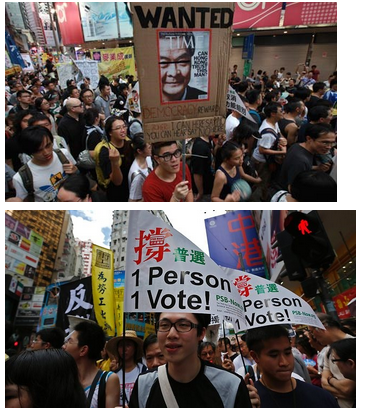
Political freedom isn't the only impetus for the hundreds of thousands of pro-democracy protesters who this week marched through central Hong Kong. True, the immediate cause was the Chinese government’s recent efforts to assert greater control over Hong Kong. But that’s not all of it, by any means. Tensions between citizens of Hong Kong and mainland China have been increasing for several years now, metastasizing into cross-border online shouting matches that have made strong impressions on people -- and governments -- in both places. 

Earlier this year, mainland Chinese were shocked by a deplorable incident in which Hong Kong locals sprayed mainland tourists with water from bottles labeled “locust insecticide.” As most every mainland Chinese knows by now, "locust" is what tens of millions of Chinese tourists who visit Hong Kong annually were labeled in a notorious 2012 advertisement in Hong Kong’s most ardent pro-democracy newspaper, the Apple Daily. (The ad was paid for by 800 donors responding to a Facebook campaign.) It was an ugly message, and it served little purpose beyond highlighting an intractable cross-border culture war -- all the while convincing many Chinese that to be pro-democracy is to be anti-Chinese. 

The contrast of world views, and the hate it engenders, is profound. In the eyes of many Hong Kong residents, mainland Chinese are uncouth buffoons with bulging wallets, no manners, and no deference to Hong Kong's status as a more highly developed and cultured gem. (Imagine Manhattanites reacting to an influx of Texans.) For mainlanders, Hong Kong residents are snobs who fail to accept that they belong to One China. The skirmishes between the two -- mostly conducted online -- are depressingly predictable, typically opening with a mainland Chinese tourist committing a petty offense that would hardly be noticed, much less prosecuted, back home. 

2014年6月29日 星期日

Latest News Clips2014.06.30

               
  1. Ukraine signs landmark agreement with E.U. 
 The Washington Post   2014.06.27 


Ukraine signed a landmark trade and economic pact with the European Union on June 27. Ukrainian President Petro Poroshenko said it is the "most historic day" for Ukraine since it gained independence. (  / European Union) 

   
KIEV, Ukraine — Shrugging off Russian threats and a burgeoning civil war, Ukraine signed a landmark trade deal Friday binding it to the European Union, a monumental step that came in defiance of months of Kremlin efforts to prevent the country from turning westward. 

The move prompted a top Russian diplomat to warn immediately of “serious consequences” for Ukraine. A cease-fire that has brought some measure of calm to the country’s roiling east was extended until Monday, and E.U. leaders hinted that they would slap more sanctions on Russia if it does not take steps to achieve peace by that deadline. 

The document signed Friday was the same one that was rejected in November by Ukraine’s then-president, Viktor Yanukovych. That decision sparked months of protests by pro-Western Ukrainians, a crackdown by Yanukovych and his eventual ouster in February, generating the highest tensions between the West and Russia since the Cold War. 

More than 100 protesters died in Kiev under the blue and yellow banner of the European Union when they took to the streets to demand that Yanukovych reconsider his last-minute decision — made under heavy Russian pressure — to reject the agreement. Hundreds more Ukrainians and dozens of Russians have died in violence in eastern Ukraine since April, when pro-Russian separatists seized government buildings and territory in an effort to align themselves with Russia rather than the European Union. 

More than 160,000 Ukrainians have been displaced from their homes since the start of the conflict, the U.N. refugee agency said Friday. 

  1. Redrawn Lines Seen as No Cure in Iraq Conflict 
The New York Times  JUNE 26, 2014 
Clerics in support of the Mahdi Army marched last week in a show of force against ISIS in Najaf, Iraq. Shiites are taking up arms across the country and calling on civilians to join the fight. CreditLynsey Addario for The New York Times 

ISTANBUL — Over the past two weeks, the specter that has haunted Iraq since its founding 93 years ago appears to have become a reality: the de facto partition of the country into Sunni, Shiite and Kurdish cantons. 
With jihadists continuing to entrench their positions across the north and west, and the national army seemingly incapable of mounting a challenge, Americans and even some Iraqis have begun to ask how much blood and treasure it is worth to patch the country back together. 
It is a question that echoes not only in Syria — also effectively divided into mutually hostile statelets — but also across the entire Middle East, where centrifugal forces unleashed by the Arab uprisings of 2011 continue to erode political structures and borders that have prevailed since the collapse of the Ottoman Empire a century ago. 

Yet Iraq and Syria’s potential fragmentation along sectarian or ethnic lines is not likely to offer any solution to the region’s dysfunction, analysts say, and may well generate new conflicts driven by ideology, oil, and other resources. 

How Syria and Iraq’s Borders Evolved 
PUBLISHED JUNE 26 
The Islamic State in Iraq and Syria is trying to establish its own Sunni state across borders that have their origins in the Ottoman Empire and post World War I diplomacy. 

Ottoman Empire 
  
Before WWI, the Middle East was divided into several administrative provinces under the Ottoman Empire. Modern Iraq is roughly made up of the Ottoman provinces of Mosul, Baghdad, and Basra. 
“At least a third of the country is beyond Baghdad’s control, not counting Kurdistan,” said Zaid al Ali, an Iraqi analyst and the author of “The Struggle for Iraq’s Future.” “But any effort to make that official would likely lead to an even greater disaster — not least because of the many mixed areas of the country, including Baghdad, where blood baths would surely ensue as different groups tried to establish facts on the ground.” 
The Obama administration has urged Iraqi politicians of different sects to come together, repeating admonitions that were so often heard in the years after the 2003 invasion. But the Pentagon — reluctant to commit more manpower to a complex and profoundly uncertain conflict — has quietly hinted it could live with Iraq’s current division, despite the dangers posed by a potential new terrorist sanctuary in the deserts linking Syria and Iraq. 
The context this time is different from a decade ago: Sectarian hatred has begun to alter the region’s political DNA in ways that make the old borders more vulnerable. Many ordinary Sunnis describe the seizing of Mosul and other cities as a popular revolution against a Shiite-led government, not a terrorist onslaught. With Iran, their historic enemy, now lining up drones and other military supplies to help the government of Prime Minister Nuri Kamal al-Maliki retake the north — and protect the south — many Sunnis may become further alienated from the state. 

  1. China Official Cancels Appearances After Protests in Taiwan 
Taiwan's Mainland Affairs Said Changes Made in Due to a Spate of 'Conflicts' in Recent Days 
The Wall Street Journal  June 28, 2014  

Security personnel protect Zhang Zhijun (center, in white shirt), after protesters attempted to pour white paint on him, in Kaohsiung,Taiwan. Reuters 

China's top cross-strait negotiator, in Taiwan on a landmark visit, canceled three public appearances at the last minute Saturday after protests against his bridge-building trip turned violent. 

Zhang Zhijun, head of Beijing's Taiwan Affairs Office, is the first ministerial-level Chinese official to set foot on Taiwanese soil after both sides split 65 years ago. Mr. Zhang's office said his four-day trip, which started on Wednesday, is to "listen to the voice of the Taiwanese people at the grass root level" as both sides strive for further reconciliation. 
In a text message to reporters on Saturday morning, Taiwan's Mainland Affairs Office, responsible for coordinating the trip with its Chinese counterpart, said the changes were made in response to a spate of "conflicts" in recent days. 
On Friday evening, during his visit to the southern city of Kaohsiung, members of the pro-democracy Black Island Nation Youth Front threw white paint and bundles of paper ghost money at Mr. Zhang's vehicle as he was getting out of the car. Mr. Zhang wasn't hurt but several security agents were splashed with paint. 
Earlier that morning, also in Kaohsiung, a young male protester sustained a laceration to his forehead during a violent quarrel with a group of China supporters in front of the hotel where Mr. Zhang was staying. The Chinese envoy was also almost hit by a water bottle thrown by a Taiwan independence activist as he arrived at the city's high speed railway station. 
During his visit to New Taipei City in northern Taiwan, hundreds of placard-waving protesters shouting, "Taiwan, China, one country each side," followed Mr. Zhang to almost every place he visited. In another heated scuffle, a group of students who had formed a human blockade by chaining themselves together were forcefully removed by the police so Mr. Zhang's motorcade could pass through. 
Thousands of police officers and security agents were mobilized to accompany Mr. Zhang on his tour of the island. At hotels where he stayed, multiple layers of barbed-wired fences pleated with razorblades were set up to fend off protesters. Police officers carrying long wooden sticks and metal shields patrolled the premises around the clock. Check points were set up to weed out demonstrators. 
Such a high level of security sparked indignant fury among protesters, who have accused the government of muting people's right to assemble and freedom of speech. 
Taiwan separated from mainland China in 1949 amid a civil strife which has never formally ended. Taiwan has since become a multiparty democracy while China has remained under communist rules. In recent years, both sides agreed to forge better trade ties by shelving their historical animosity. However, Beijing still claims Taiwan, and has said it would reclaim it by force if necessary. 
Analysts say although the scale of protest this time was smaller compared with those 2008 when another Chinese semiofficial visited Taiwan, Beijing must not interpret the lower numbers as a sign of Taiwan's gradual acceptance of unification. 
"It is important to note Taiwan people's growing distrust in the Chinese Communist Party is not only from what Beijing is doing to Taiwan such as blocking Taiwan's participation in international organizations, but also what Beijing is doing in Hong Kong and in the region," said Mingchuan University professor Chen Chao-chien, referring to China's seemingly provocative moves in both South and East China Seas amid rising tension among the various territorial claimants. 
The professor said Mr. Zhang's trip, which including serving lunch at a local senior center and a forum with university students, is in line with China's "two-faced approach"—to be soft and hard on Taiwan at the same time. 
However, others say the fact that even the opposition Democratic Progressive Party showed no objection to Mr. Zhang's visit means China's plan to lure back Taiwan through economic sweeteners is slowly taking effect, said Chang Kuo-cheng, a Taipei Medical University professor and a member of the Taiwan Thinktank. 
But one thing that most political observers agree on is that Beijing is growing more anxious to start the political dialogue phase of the relationship after six years of focusing only on trade matters. 
"We urged the Taiwan public to be respect [to Mr. Zhang] but, Taiwan is [a] democracy where everyone has a right to voice their opinion and we ask China to respect the choices made by the Taiwanese people," said Wang Yu-chi, the head of Taiwan's Mainland Affairs Council at a news conference. 
"On this trip, Mr. Zhang heard many different views. We believe this has been a fruitful trip for him," he said. 


2014年6月22日 星期日

Latest News Clips 2014.06.23


1.  Iraq’s Sectarian Nightmare
Project Syndicate  JUN 18, 2014

   
DENVER – With the apparent conquest of Iraq’s northwestern provinces – and maybe more – by the militant Islamic State in Iraq and Syria (ISIS), the country’s troubled history has opened a horrifying new chapter. In a matter of just days, ISIS’s fighters overran Anbar, Ninewa, and Salahaddin provinces – a victory that attests to the central government’s non-existent authority in Sunni-majority areas. And, given ISIS’s jihadi ideology, there is limited scope for “Sunni outreach” – the supposed panacea for all that ails Iraq’s sectarian political culture.
ISIS is not a group that is receptive to dialogue. Its leadership adheres to the view, expressed in many corners of the Arab Sunni world, that Shia Muslims are apostates and betrayers of Islam who rank among the worst of the worst (alongside Israel and the United States). This means that the US needs both a military response to ISIS and a political response that extends beyond Iraq. What is needed, above all, is a regional approach to the increasingly murderous Sunni-Shia rivalry.
                                                        
It is worth remembering that the original sin of the US-led occupation of Iraq 11 years ago was so-called “de-Ba’athification” – the purge of any and all people with ties to Saddam Hussein’s Ba’ath party. That decision was taken in the year following the 2003 invasion, when Iraq was a wholly-owned US subsidiary; Iraqi officials, whether Shia or Sunni, had almost nothing to do with it.
It is often said that Iraq needs a Nelson Mandela; the same could be said of US policymakers back then. In the ideologically charged US policy circles of the time, de-Ba’athification was understood to be a decisive move to extirpate a heinous ideology. It was likened to the de-Nazification of Germany following World War II.

2.  Messi Rubs ‘Lamp’ to Give Argentina Late Win Over Stubborn Iran
The Bloomberg  Jun 21, 2014

Once again, Argentina needed a moment of inspiration from Lionel Messi.
For the second match in soccer’s World Cup in Brazil, two-time champion Argentina struggled with lower-ranked opposition. With last night’s game in injury time, Messi took control. The 91th-minute goal from the four-time World Player of the Year made it 1-0 and allowed thousands of fans in Belo Horizonte’s Estadio Mineirao to celebrate.
Messi cut inside the defense and keeping the ball on his left foot -- just like he had when his goal gave his team its tournament-opening 2-1 win against Bosnia-Herzegovina on June 15 -- placed it beyond the goalkeeper.
“Thanks be to God, the little guy rubbed the lamp in the last minute and we won,” said Argentina goalkeeper Sergio Romero, who had several second-half saves to ensure Iran -- ranked 38 places below Argentina -- didn’t get an upset.
Argentina is now guaranteed a place in the next round. It will seek to continue the winning streak to secure top position in Group F when it plays Nigeria in Porto Alegre in three days, according to defender Pablo Zabaleta. Iran may still qualify if it beats Bosnia on the same day.
“Obviously we are not performing as we want to perform,” he said after the                                                       
game. “Sometimes it’s just about the three points.”
Blue and White
More than 30,000 Argentines traveled to the city in southern Brazil, and the stadium was draped in blue and white.
Argentine coach Alejandro Sabella ended an experimental set up of five defenders, which cramped his team in the first half against Bosnia. He restored Gonzalo Higuain in the attack alongside Messi and Sergio Aguero.
The trio found very little space to maneuver as Iran chased every loose ball and defended tightly. Argentina’s 77 percent possession in the match was the second highest in any World Cup game since 1966, according to sports statistician Opta.
“We need space to play well and Iran didn’t give us any,” Messi said. “We can play better but it’s tough when the opponent protects their goal so well.”                                                  
During the second half, Argentina’s frustration meant more attackers flooded the opposition half, and the Iranians took advantage with quick counterattacks.
Iranian Attacks
First Reza Ghoochannejhad forced Romero into a diving save with a header following a break led by Masoud Shojaei. Two minutes later, referee Milorad Mazic of Serbia declined to give a penalty when Zabaleta got the ball but also 
a piece of the attacker with his tackle of Ashkan Dejagah inside the penalty area.
Iran coach Carlos Queiroz said Mazic deserved as much credit as Messi for the result.
“Two people made the difference in the game,” he said. “One was Messi for his brilliant strike. The second, who should not have made a difference, was the referee. It was a clear penalty and in a game like this against a team like Argentina, these small details can be crucial.”
Zabaleta said the referee made the right call, saying “it was not very clear to give a penalty.”
Messi had his first run at goal an hour into the game. Picking up the ball in the Iran half, he moved toward the defense before hitting a left-foot shot just                                                           
wide.
At the other end Romero blocked Haji Safi’s shot wide, and the goalkeeper then denied Ghoochannejhad on another counter attack.
With the clock ticking past the 90th minute, Messi produced his goal. He fired his shot into the top corner from 25 meters (30 yards), sending Iran players onto their haunches.
“He’s the best player in the world and sometimes he makes things like this,” Zabaleta said. “He has the quality to decide a game any time and today was really hard because they defended really well for 90 minutes and then Messi made the difference at the end.”


3.  After reading this, you’ll never look at a banana in the same way again
This is interesting. After reading this, you’ll never look at a banana in the same way again.
Bananas contain three natural sugars – sucrose, fructose and glucose combined with fiber. A banana gives an instant, sustained and substantial boost of energy. Research has proven that just two bananas provide enough energy for a strenuous 90-minute workout. No wonder the banana is the number one fruit with the world’s leading athletes. But energy isn’t the only
                                                       
way a banana can help us keep fit. It can also help overcome or prevent a substantial number of illnesses and conditions, making it a must to add to our daily diet.

                                                   
DEPRESSION
According to a recent survey undertaken by MIND amongst people suffering from depression, many felt much better after eating a banana. This is because bananas contain tryptophan, a type of protein that the body converts into serotonin, known to make you relax, improve your mood and generally make you feel happier.
PMS:
Forget the pills – eat a banana. The vitamin B6 it contains regulates blood glucose levels, which can affect your mood.
ANEMIA
High in iron, bananas can stimulate the production of hemoglobin in the blood 
and so helps in cases of anemia.

BLOOD PRESSURE:
                                                      
This unique tropical fruit is extremely high in potassium yet low in salt, making it perfect to beat blood pressure So much so, the US Food and Drug Administration has just allowed the banana industry to make official claims for the fruit’s ability to reduce the risk of blood pressure and stroke.
BRAIN POWER
200 students at a Twickenham school ( England ) were helped through their exams this year by eating bananas at breakfast, break, and lunch in a bid to boost their brain power. Research has shown that the potassium-packed fruit can assist learning by making pupils more alert.
CONSTIPATION
High in fiber, including bananas in the diet can help restore normal bowel action, helping to overcome the problem without resorting to laxatives.
HANGOVERS
One of the quickest ways of curing a hangover is to make a banana milkshake, sweetened with honey. The banana calms the stomach and, with the help of the honey, builds up depleted blood sugar levels, while the milk                                                
soothes and re-hydrates your system.
HEARTBURN
Bananas have a natural antacid effect in the body, so if you suffer from heartburn, try eating a banana for soothing relief.
MORNING SICKNESS
Snacking on bananas between meals helps to keep blood sugar levels up and avoid morning sickness.
MOSQUITO BITES:
Before reaching for the insect bite cream, try rubbing the affected area with the inside of a banana skin. Many people find it amazingly successful at reducing swelling and irritation.
NERVES
Bananas are high in B vitamins that help calm the nervous system..
Overweight and at work? Studies at the Institute of Psychology in Austria found pressure at work leads to gorging on comfort foodlike chocolate and chips. Looking at 5,000 hospital patients, researchers found the most obese were more likely to be in high-pressure jobs. The report concluded that, to avoid panic-induced food cravings, we need to control our blood sugar levels 
by snacking on high carbohydrate foods every two hours to keep levels steady.
ULCERS
The banana is used as the dietary food against intestinal disorders because of its soft texture and smoothness. It is the only raw fruit that can be eaten without distress in over-chroniclercases. It also neutralizes over-acidity and reduces irritation by coating the lining of the stomach.
TEMPERATURE CONTROL
Many other cultures see bananas as a ‘cooling’ fruit that can lower both the physical and emotional temperature of expectant mothers. In Thailand , for example, pregnant women eat bananas to ensure their baby is born with a cool temperature.
So, a banana really is a natural remedy for many ills. When you compare it to an apple, it has FOUR TIMES the protein, TWICE the carbohydrate, THREE TIMES the phosphorus, five times the vitamin A and iron, and twice the other vitamins and minerals.. It is also rich in potassium and is one of the best value foods around So maybe its time to change that well-known phrase so that we say, ‘A BANANA a day keeps the doctor away!’