1. Xi strikes conciliatory tone on trade but offers few
concessions
Chinese president’s comments may be enough to tamp down escalating
rhetoric
The Guardian 11
Apr 2018
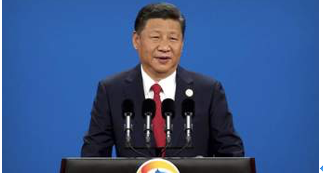
Xi
Jinping speaking at the Boao Forum for Asia in Boao, Hainan province, China.
Photograph: Kyodo/Reuters
Xi
Jinping filled his speech at an annual business summit on Tuesday with
aphorisms about hard work and openness. “Heaven rewards the diligent,” the Chinese
president said, applauding his country’s achievements. The march of history
towards economic liberalisation was irreversible, he said at another point,
restating China’s commitment to free trade.
Then
he slipped in a Chinese proverb: “Heaven has its own law and those who embrace
it will prosper.” The saying, meant to celebrate China’s unique blend of
socialism and a market-driven economy, contained another message: that Chinawould continue to play
by its own rules.
Xi’s
remarks – his first public comments since Beijing and Washington began sparring
over tariffs – at first appeared conciliatory. He pledged to further open up
China’s financial services sector, lower tariffs on car imports, encourage
other imports and better protect intellectual property – the latter issue being
one of the key grievances of Donald Trump’s White House.
But
US investors and businesses have been hearing most of these
promises for at least the past two years. Some of the pledges will have minimal
impact. For instance, lowering import duties on cars will benefit relatively
few US companies, most of which already produce and ship their vehicles from
within China.
Xi
also promised to open up China’s shipbuilding and manufacturing sectors, though
Andrew Collier, the managing director of Orient Capital Research, noted that
manufacturing had been relatively accessible to foreign investors since China joined
the World Trade Organisation in 2001. “Xi delivered a masterful, carefully
framed, conciliatory response to Trump,” Collier said.
The
US president said on Tuesday after Xi’s speech that he was “very thankful” for
the Chinese leader’s pledges on tariffs and the car industry. “We will make
great progress together!” he tweeted.
The
US has threatened to impose tariffs on as much as $150bn (£105bn) of Chinese
imports in response to what it says are unfair Chinese trade policies that
protect domestic markets while forcing foreign companies to hand over their
technology and intellectual property. China has responded with its own list of
US goods it could levy, including soya beans, aircraft and other major US
exports, many of which come from battleground states influential in
upcoming midterm elections.
“China
seems to have gotten a lot of mileage from Xi’s rote statements and minor
concessions that Trump has turned around and spun as evidence of his
deal-making prowess,” said Eswar Prasad, a senior professor on trade policy at
Cornell University in the US and senior fellow at the Brookings Institution.
Xi’s
speech, which had been expected to set out bold reforms, was instead similar to
his remarks in Davos last year. In that speech he framed China as the world’s
new champion of free trade in an implicit
rebuke to Trump. On Tuesday Xi again emphasised China’s commitment to economic
openness.
“China’s
cheek is something to behold given that they are building a new international
order alongside the one they pledged to leave undisturbed,” wroteRichard
McGregor, a senior fellow at the Lowy Institute in Sydney.
One
of China’s key industrial policies is aimed at replacing foreign technology
with domestically made components and establishing Chinese companies as global
champions. Much of the White House’s tariffs target the policy, known as Made in China 2020.
Xi’s
comments, while offering little, may still be enough to tamp down escalating
rhetoric. Some of the measures Xi named appear to be moving forward, which
could also help. The People’s Bank of China said on Wednesday that previously announced
moves to put foreign companies on an equal footing with domestic rivals in the
financial services sector would be implemented by the end of the year.
“China
is laying a preliminary foundation to talk with the US,” said Pang Zhongying, a
Beijing-based international relations expert. “I think the time is gradually
coming for China and the US to negotiate.”
2.Kim Jong
Un: North Korea no longer needs nuclear tests, state-run media reports
CNN April 21, 2018
 |
Seoul, South Korea (CNN)North Korea says its quest for nuclear weapons is
"complete" and it "no longer needs" to test its weapons
capability, a significant development ahead of diplomatic engagement with both
South Korea and the United States.
North
Korean leader Kim Jong Un said Saturday that "under the proven condition
of complete nuclear weapons, we no longer need any nuclear tests, mid-range and
intercontinental ballistic rocket tests, and that the nuclear test site in
northern area has also completed its mission," as quoted by the state-run
KCNA news agency.
The
announcement appears to signify a remarkable change in policy for Kim,
following a relentless pursuit of nuclear and ballistic weapons as a means to
ensure his regime's survival -- although some analysts remain skeptical, pointing
out that Kim hasn't tested a missile since last November.
The
news comes just six days before a meeting between Kim and South Korean
President Moon Jae-in, a precursor to a much-anticipated planned encounter
between Kim and US President Donald Trump, expected to take place at the end of
May or beginning of June.
It
also comes just weeks after the North Korean leader met Chinese President Xi
Jinping on his first official trip outside his country.
The
US and South Korea welcomed the news, which they said was a sign of progress
and a promising start to upcoming talks.
"North
Korea has agreed to suspend all Nuclear Tests and close up a major test
site," Trump tweeted. "This is very good news for North Korea and the
World - big progress! Look forward to our Summit."
North Korea has agreed to suspend all Nuclear Tests and
close up a major test site. This is very good news for North Korea and the
World - big progress! Look forward to our Summit.
The
US President followed up the tweet with another around four hours
later, similarly praising the "progess" being made.
Seoul
similarly praised the development, with South Korean Presidential Senior
Secretary for Public Relations Yoon Young-chan telling journalists it
represented "meaningful progress for denuclearization of the Korean
peninsula," and said that it would contribute to a "positive
environment" for the upcoming talks.
The
declaration comes as North Korea continues to make concessions ahead of the
talks. Last month Kim told a South Korean delegation that he "understood" the need for joint
US-South Korean military drills. Earlier this week he dropped his requirement that US
troops leave the Korean peninsula as a precondition for
denuclearization.
'New chapter' for North
Korea
A
North Korea source told CNN that Kim has finally decided to open up a new
chapter for his nation. Kim has committed himself to the path of
denuclearization and will now focus solely on economic growth and improving the
national economy, the source said.
The
North Korean leader has realized the best path forward is to normalize
relations with other countries, the source added. He is finally being
recognized by the international community, and this is a historic, timely
opportunity, the source said.
Japanese
Prime Minister Shinzo Abe cautiously welcomed the development. "The only
thing that is important is whether or not it will lead to the completely
verified and irreversible abolition of nuclear and missiles," he told
reporters. "We would like to keep a close eye on it."
His
Defense Minister, Itsunori Onodera, went one step further, saying that the
suspension of nuclear and missile tests was "insufficient" and
"not satisfactory," as it did not mention Pyongyang's short- and
mid-range capabilitiies -- the missiles that can reach Japan.
Beijing
welcomed the news and pledged to play a "positive" role in bringing
lasting peace to the peninsula.
"Achieving
denuclearization and sustainable peace in the region is in the interest of
people on the peninsula and in the region, and meets the shared expectation of
the international community," Chinese Foreign Ministry spokesman Lu Kang
said.
"We
hope all relevant parties will move in the same direction and take concrete
actions to work toward sustainable peace and common development in the region.
China will continue to play a positive rolte to this end."
However, analysts stressed caution over Kim's words,
noting that Pyongyang was likely to be seeking something in return.
"The
announcement is significant, but you know, whether North Korea is truly serious
remains to be seen," said Sue Mi Terry, a former CIA North Korea analyst.
"They
might be looking for freeze-for-freeze deals. They are looking for sanctions
relief. So what are we going to give for this freezing of tests?"
3.Reinventing
wheels Autonomous vehicles are just around the corner
Driverless vehicles will change the world, just as cars did before them.
What went wrong last time round holds valuable lessons for getting it right
this time, says Tom Standage

The Economist Mar 1st 2018
EVERY
DAY AROUND 10m people take an Uber. The company has made ride-hailing
commonplace in more than 600 cities in 82 countries. But the Volvo XC90 picking
its way through traffic on a wintry morning in Pittsburgh is no ordinary Uber.
Climb into the back, and you will see a screen mounted between the front seats,
showing a digital representation of the world around the car, with other
vehicles, pedestrians and cyclists highlighted as clusters of blue dots. Tap
the screen to say you are ready to leave, and the car starts to move. But no
one is driving it. This Uber is an autonomous vehicle (AV)—a car that can drive
itself.
Admittedly,
Uber’s self-driving robotaxi has a human sitting in the driving seat, but only
to take over if something unexpected happens. The car drives carefully but
confidently in downtown traffic and light snow, handling four-way stops,
traffic lights and pedestrian crossings with aplomb. It even knows how to deal
with drivers performing the “Pittsburgh left”, a local custom that allows the
first vehicle at a traffic light to turn left in front of oncoming traffic. The
most noticeable difference from a human driver is that the vehicle makes no
attempt to avoid Pittsburgh’s notorious potholes, so the ride is slightly bumpy
at times. The engineer in your correspondent’s robotaxi takes over
occasionally, for example to guide the car through roadworks where the lane
markings have recently been changed.
Autonomous
vehicles are not yet quite ready to operate without human supervision, then.
But they have made rapid progress in recent years, and can now be seen on the
roads in several American cities, easily identified by the clusters of sensors
on their roofs. Uber’s robotaxis ferry riders around in Pittsburgh and Phoenix.
Waymo, Google’s self-driving car unit which is now a separate company in the
Alphabet family, has gone a step further, operating autonomous minivans in
Chandler, a suburb of Phoenix, without safety engineers in the driving seat. It
plans to launch a commercial ride-hailing service there this year. GM,
America’s biggest carmaker, hopes to launch a robotaxi service in 2019 using
autonomous Chevy Bolt cars that do not even have steering wheels or pedals.
AVs
operated by tech giants, startups and established carmakers can also be seen
around Silicon Valley and Pittsburgh, America’s two main hubs of the emerging
industry, drawing on talent from Stanford and Carnegie Mellon universities
respectively. In other parts of the world, driverless shuttles ferry passengers
on university campuses, in business parks or along special bus lanes. AVs stole
the show at CES, the world’s biggest technology fair, in Las Vegas in January.
Suddenly, it seems, everybody is jumping on the driverless bandwagon.


