1. In
Crisis, Angela Merkel Prefers Elections to Minority Rule
The New York Times NOV.
20, 2017
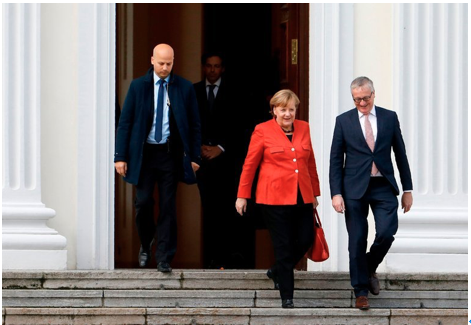
Chancellor
Angela Merkel in Berlin on Monday. She said she remained hopeful about forming
a majority government. CreditOdd Andersen/Agence France-Presse — Getty
Images
BERLIN
— Chancellor Angela Merkel of Germany faced the greatest crisis of her career
on Monday after negotiations to form a new government collapsed, shaking a
country that is Europe’s political and economic anchor.
The
breakdown abruptly raised the prospect of new elections in Germany. It came
less than two months after the last elections seemed to assure that Ms. Merkel,
an icon of Western democracy and values, would remain Germany’s leader for a
fourth term.
The
chancellor said she remained hopeful about forming a majority government. But
if forced to choose, Ms. Merkel said, she would prefer to go through new
elections rather than try to lead a minority government.
“I
don’t want to say never, but I am very skeptical, and believe that new
elections would be the better way forward,” the chancellor told the public
broadcaster ARD.
At
a time when the European Union is facing a host of pressing problems, from
Brexit negotiations with Britain, to the rise of right-wing populism, to
separatism in Spain’s Catalonia region, the possibility of political
instability in a normally reliable Germany sent tremors through the Continent.
The
collapse of talks reflected the deep reluctance of Ms. Merkel’s conservative
bloc and prospective coalition partners — the ecologist-minded Greens and
pro-business Free Democrats — to compromise over key positions. The Free Democrats quit the talks late
Sunday, citing what they called an atmosphere of insincerity and mistrust.
“There
is no coalition of the willing to form a government,” said Thomas Kleine-Brockhoff, director of the Berlin
office of the German Marshall Fund. “This is uncharted territory since 1949.
We’re facing a protracted period of political immobility. Not only is this not
going to go away soon, there is no clear path out.”
Calling
new elections is not a straightforward procedure in Germany. Written with the
unstable governments of the 1920s and 1930s and collapse of the Weimar Republic
in mind, the German Constitution includes several procedural hurdles that would
ensure a prolonged and difficult process.
Some
were quick to link Germany’s disorder to a broader crisis of democracy in the
West. “The unthinkable has happened,” said Christiane Hoffmann, deputy head of
the Berlin bureau of Der Spiegel, a German magazine. In that sense, she said,
“This is Germany’s Brexit moment, its Trump moment.”
Others
said Germany’s troubles were in many ways just a sign that the country was
becoming more normal, not less. Having had only four chancellors since 1982,
the country has known only a string of centrist governments that governed by
consensus.
The
crisis erupted seven weeks after the last election, which brought the
right-wing Alternative for Germany, or AfD, into Parliament, and in some ways
represented the return of politics to a country long deprived of debate and
policy disagreements.
“It’s
just another step in the long learning of democracy of Germany since World War
II, going from a very stable proportional system to something more messy,” said
Henrik Enderlein, dean of the Hertie School of Governance in Berlin.
The
bigger question, he said, was whether Ms. Merkel’s pragmatic governing style
had reached its limit in an era where people crave the clash of a wider
spectrum of policies. “Her über-pragmatism is reaching its end,” he said. “It’s
hard to see a scenario where she returns to her previous position of power.”
2. When Our Allies Are Accused of Harassment
The New York Times NOV. 20, 2017

Last
Thursday, after a photograph emerged of Senator Al Franken either groping or
pretending to grope a sleeping woman, Leeann Tweeden, with whom he’d been
traveling on a 2006 U.S.O. tour, I wrote that he should resign. Almost as soon as it
was published I started having second thoughts. I spent all weekend feeling
guilty that I’d called for the sacrifice of an otherwise decent man to make a
political point.
Then
I saw the news that a woman named Lindsay Menz accused Franken of grabbing
her butt while they posed for a photo at the Minnesota State Fair in 2010, when
he was a senator, and I read Franken’s lame non-denial: “I feel badly that Ms.
Menz came away from our interaction feeling disrespected.”
Yet
I am still not sure I made the right call. My thinking last week, when the
first accusation emerged, was: cauterize the wound. It doesn’t matter that
Franken’s transgression wasn’t on the same level as the abuses that the Alabama
Senate candidate Roy Moore or Donald Trump have been accused of. That photo —
the unconscious woman, the leering grin — is a weight Democrats shouldn’t have
to carry, given that they’ve lately been insisting that it’s disqualifying for
a candidate to grab a woman sexually against her will. It seemed cruel to
expect Democratic women to make Jesuitical arguments that the shadows under
Franken’s hands meant he wasn’t really touching Tweeden’s chest. Especially
since, with a Democratic governor in Minnesota, the party would maintain
control of Franken’s seat.
But
even as I made the case for resignation, I was relieved that it seemed as if
Franken might stick around, because I adore him as a public figure. It’s easy
to condemn morally worthless men like Trump; it’s much harder to figure out
what should happen to men who make valuable political and cultural
contributions, and whose alleged misdeeds fall far short of criminal. Learning
about all the seemingly good guys who do shameful things is what makes this
moment, with its frenzied pace of revelations, so painful and confounding.
Personally,
I’m torn by competing impulses. I want to see sexual harassment finally taken
seriously but fear participating in a sex panic. My instinct is often to defend
men I like, but I don’t want to be an enabler or a sucker. I try not to be a
hypocrite, while being aware that the right plays on the media’s desire to seem
fair-minded, which is part of what led to wildly excessive coverage of Hillary
Clinton’s emails during the presidential campaign, among other distortions.
It’s
not a coincidence that the post-Harvey Weinstein purge of sexual harassers has
been largely confined to liberal-leaning fields like Hollywood, media and the
Democratic Party. This isn’t because progressive institutions are more sexist
than others — I’m confident there’s at least as much sexual abuse in finance as
in publishing. Rather, organizations with liberal values have suddenly become
extremely responsive to claims of sexism. Feminists, enraged and traumatized by
Donald Trump’s election, know they can’t expect accountability from
Republicans, but they’ve forced it from people who claim to share their ideals.
As a result, it sometimes feels as if liberal institutions are devouring
themselves over sex while conservatives, unburdened by the pretense of caring
about gender equality, blithely continue their misrule.
3. The 'masculine mystique' – why men can't ditch the baggage
of being a bloke
Far
from embracing the school run, most men are still trapped by rigid cultural
notions of being strong, dominant and successful. Is it leading to an epidemic
of unhappiness similar to the one felt by Betty Friedan’s 50s housewives?
‘Men
who do change their working lives to accommodate their children generally say
it can feel tough, lonely and incongruous.’ Photograph: Archive Photos/Getty
Images
The Guardian 21 November 2017

Back
in the 90s, it was all going to be so different. Not for our generation the
lopsided approach of our parents, with their quaint postwar notions of
father-breadwinners and mother-homemakers. We would be equal; interchangeable.
Our young women would run companies, embassies, hospitals and schools, while
our young men, no slouches themselves, would punctuate their careers with long,
halcyon spells dandling babies and teaching toddlers how to make tiny volcanoes
out of vinegar and baking soda.
That
equality would have formidable knock-on effects. The gender pay gap would
narrow. Sexual harassment wouldn’t disappear,
but decoupling professional power from gender would do a lot to erase it from
the workplace.
A
generation or so later, it is clear: this is the revolution that never
happened, at least not in the UK. The home-dad pioneers among us who once
blazed a trail, now look on aghast as successive waves of men scurry past and
say: “Right. Back to work.”
What
happened? Latest statistics for England show more than 80%
of fathers still work full time, rising to almost 85% for dads of very young
children. This rate has barely changed for 20 years. The ratio of part-timers
has flatlined just above 6% throughout this decade (having soared through the
90s and early 00s). Just 1.6% of men have given up work altogether to take care
of the family home. New rights for fathers to share parental leave with mothers
have poor take-up rates.
You
can glimpse this paternity gap at 3.30pm on weekday afternoons at school gates
up and down the country. Far from being overrun with gaggles of enlightened men
in clothes covered with baby sick and badges saying “World’s greatest dad”, the
father quota is, in my own limited experience, disappointing. There are often
more grandparents doing the pickup than dads.
At
the same time, there is no shortage of surveys finding legions of men saying they want to
find more time for family life. So what is stopping them?
In
1963, The Feminine Mystique, a seminal book by Betty Friedan, helped launch the
second wave of feminism by positing that American women faced “a problem that
has no name”: they had essentially become typecast as uber-feminine mothers,
home-makers, cake bakers and sexual slaves to their husbands. Forcing women to
live up to this idea of femininity left an entire generation depressed,
frustrated or hooked on Valium.
The
question is this: 50 years later, are men facing their own “problem with no
name”, a “masculine mystique” which imposes rigid cultural notions of what it
is to be male – superior, dominant, hierarchical, sexually assertive to the
point of abuse – even though society is screaming out for manhood to be
something very different?
Men
who do change their working lives to accommodate their children generally say
it can feel tough, lonely, incongruous, even emasculating. When, 15 years ago,
I gave up work altogether for a year to do childcare, it took a while to get
used to being the only dad in the park; the strange man arguing with a
difficult child outside the library on a damp Tuesday morning. People stared.
David
Early and his son Jonah … ‘There is a stigma when people see you doing a role
that isn’t traditional.’
Little
has changed. Father-of-two David Early, 31, from Glasgow, says he still feels
in a minority when he is out and about with his toddlers. “When I’m with the
children, and I have her in the sling and him in the buggy, I have people
looking and thinking: ‘What’s that guy doing with two kids strapped to him?’”
says Early. “There is a stigma when people see you doing a role that isn’t
traditional. It can impact on your professional life.”


